Product links on this page go to Amazon. If you buy through them, Electric Tampa earns a commission. How we pick and earn
A generator makes power as long as you can feed it gasoline. A power station stores power and runs out. That one difference decides most of this, but the arithmetic is worth doing, because a battery runs the small, important loads longer than most people expect, and the big ones for less time.
The runtime formula
BLUETTI’s manual gives the formula most makers use:
Operation time = Battery Capacity × DoD × η ÷ (Load + self-consumption)
- Battery capacity is the watt-hours on the box.
- DoD (depth of discharge) is how much of it you can use: BLUETTI uses 90%.
- η is the inverter’s efficiency turning battery power into household AC: BLUETTI says over 85%.
- Self-consumption is what the station uses just being on, about 10 W.
So a 1,000 Wh station gives you roughly 1,000 × 0.9 × 0.85 ≈ 765 Wh at the outlet.
What the important things draw
- Refrigerator: the Energy Information Administration’s household survey puts the average main refrigerator at 617 kWh a year, about 1.7 kWh a day, or 70 W on average. The compressor cycles, so it draws several hundred watts while it runs and nothing in between.
- CPAP: ResMed’s battery guide measures the AirSense 10 at about 11 W without the humidifier, roughly 90 Wh for an 8-hour night, and about 59 W with the humidifier on high, roughly 470 Wh a night. ResMed recommends turning humidification off on battery power.
- Router and modem: about 6 W each, per NRDC’s measurements.
- Phones and a laptop: a few watt-hours to 50 Wh each per charge.
- A box fan: 50 to 200 W, from Champion’s wattage chart.
What each size runs
| Station | Usable at the outlet | What that covers |
|---|---|---|
| About 300 Wh | about 220 Wh | A CPAP with the humidifier off for about a night, or the router and phones for most of a day |
| About 1 kWh | about 770 Wh | The refrigerator and the router for about 8 hours |
| About 2 kWh | about 1,590 Wh | The refrigerator, a CPAP, one fan and the router overnight |
| About 4 kWh | about 3,130 Wh | The refrigerator, a CPAP, a fan and the router for about 17 hours, or a 5,000-BTU window AC for 5 to 6 hours |
These include the station’s own draw of about 10 W, which is why a small load on a big station runs shorter than the simple division suggests. Keep the fridge door shut and the compressor runs less, which stretches every row.
1 kWh power station
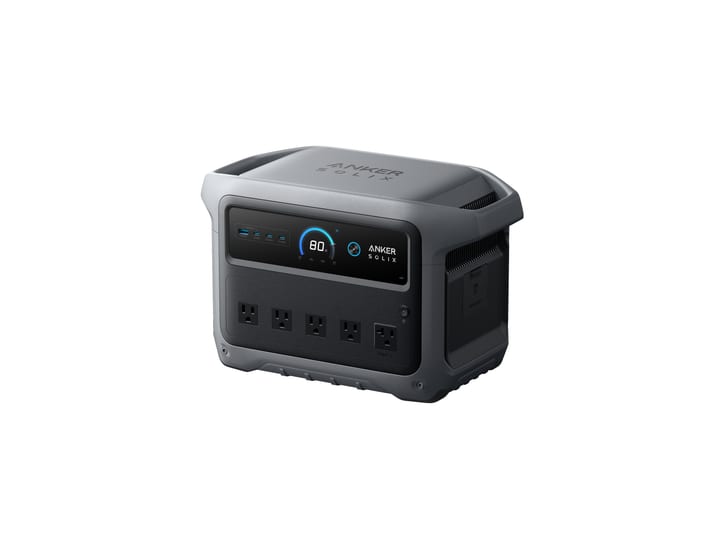
Anker SOLIX C1000 Gen 2
Anker SOLIX A1763
About 1 kWh with 2,000 W of AC output, enough to start a refrigerator, and an UltraFast mode that refills it from the wall in under an hour.
- Capacity
- 1,024 Wh, LiFePO4
- AC output
- 2,000 W (3,000 W peak)
- Solar input
- 600 W, 11–60 V
- Wall charge
- 49 min (UltraFast)
- Weight
- 24.9 lb
- UPS
- 10 ms
Suits: A refrigerator and the router for about 8 hours, recharged from a generator or up to 600 W of solar.
Weigh: Not expandable. Rated to 104 °F, so keep it out of a hot garage, and UltraFast charging only engages once the cells are above 68 °F.
Where a battery wins
- No fuel run. After Milton, most Tampa-area gas stations were dry for days. A battery and solar panels don’t need one.
- No carbon monoxide. There’s no engine and no exhaust; EcoFlow, for one, rates its DELTA Pro 3 for well-ventilated indoor use. The CDC’s rule for generators, never inside the home or garage and more than 20 feet from windows, doors and vents, doesn’t apply.
- Quiet, and instant. Most switch over in 10 to 20 milliseconds when the power drops, fast enough to keep a CPAP or a router running through the cutover.
Where a generator wins
- Big loads, long outages. Central air, a well pump, an electric water heater, or a week of everything: a generator keeps making power as long as it has fuel. A battery drains.
- Whole-house power. Through a transfer switch, one large generator covers loads that would take several battery units.
The combination
Many households end up with both: a power station inside for the overnight loads that matter, and a generator outside during the day to run the AC and recharge the battery. Several of the stations we list refill from a generator’s AC in about an hour.
Ready to size a generator instead? See how big a generator a Tampa Bay house needs.