Six portable generators from 1,800 to 9,500 running watts, every one with a carbon monoxide shutoff. Start with how much the house needs, then the fuel, then how it connects.
Which kind fits
The size follows from what has to run. Our sizing guide walks through the numbers.
Under 2,500 W
Small inverter
The fridge, fans, lights and internet on very little gas. Usually run on cords; 120 V only, so no 240 V loads.
3,500–5,500 W
Dual-fuel inverter
The essentials plus a bedroom AC or mini-split, on gas or propane. The larger ones have a 30-amp 240 V outlet for an inlet.
7,500–9,500 W
Open-frame or large inverter
Central air or a well pump plus the house, through a transfer switch. Heavy, and the open-frames are loud.
Whole house
Standby
Permanently installed on natural gas or propane, starts by itself. Sized and installed by an electrician; see the install side.
Quick picks
The short answer for common situations. Each links to the full card below.
A 47-pound inverter that runs the refrigerator, fans, lights and the internet at 48 to 57 dB(A): about 8 hours at light load on its 0.95-gallon tank.
Running / starting
1,800 / 2,200 W
Fuel
Gasoline
Run time
8.1 h at ¼ load
Noise
48–57 dB(A)
Weight
47.4 lb
CO shutoff
CO-MINDER
Suits: The essentials in a small house with outdoor space to run it 20 feet from the building, or a second generator for light overnight loads.
Weigh: Gasoline only and about 1,800 running watts. Its outlets are 120 V only, so it cannot supply 240 V loads, and it will not start a window AC with much else on.
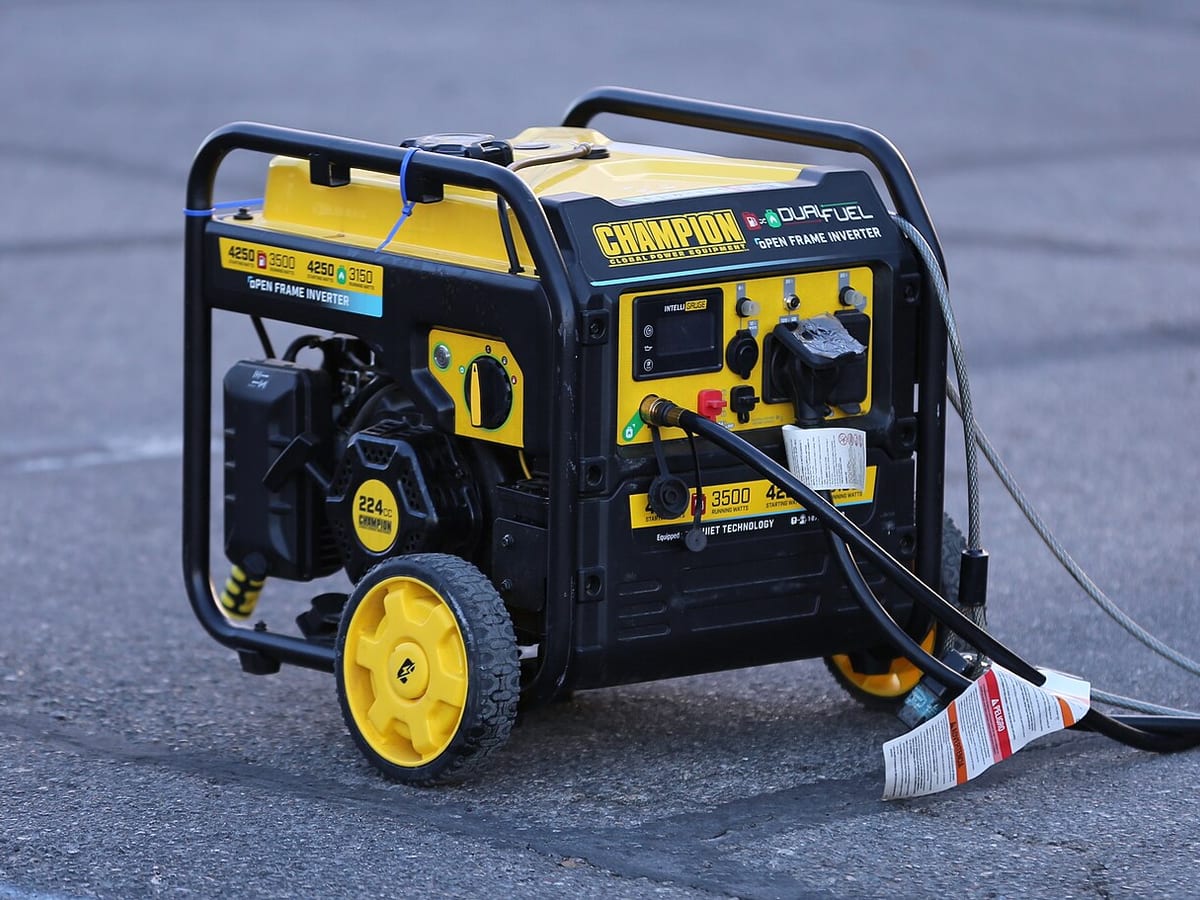
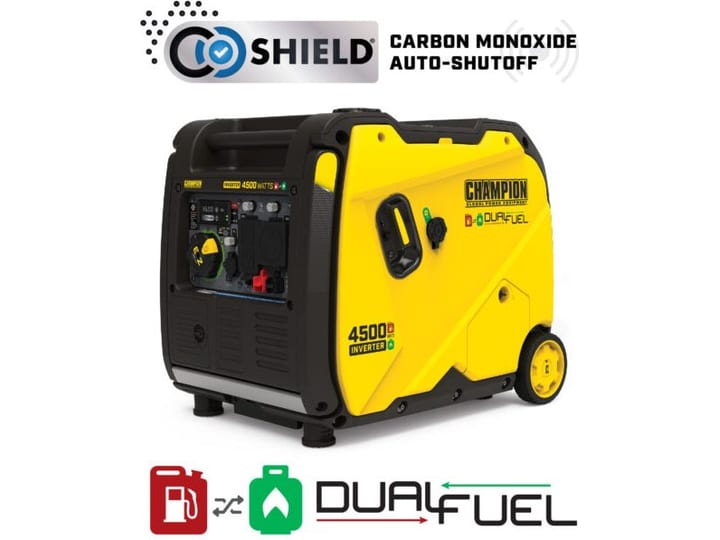
Enough for the essentials with headroom, on gasoline or a 20-pound propane tank, with electric start and a CO shutoff.
Running / starting
3,500 / 4,500 W gas
On propane
3,150 / 4,500 W
Run time
14 h gas, 21 h propane at ¼ load
Noise
61 dB(A) at 23 ft
Weight
99.2 lb
CO shutoff
CO Shield
Suits: Fridge, freezer, fans, lights, CPAP and a small window AC, by extension cords or a transfer switch for a few 120 V circuits.
Weigh: Its outlets are 120 V only (household and RV), so it cannot supply 240 V loads; an electrician can connect it to selected 120 V circuits through a listed transfer switch. About 99 pounds on wheels.
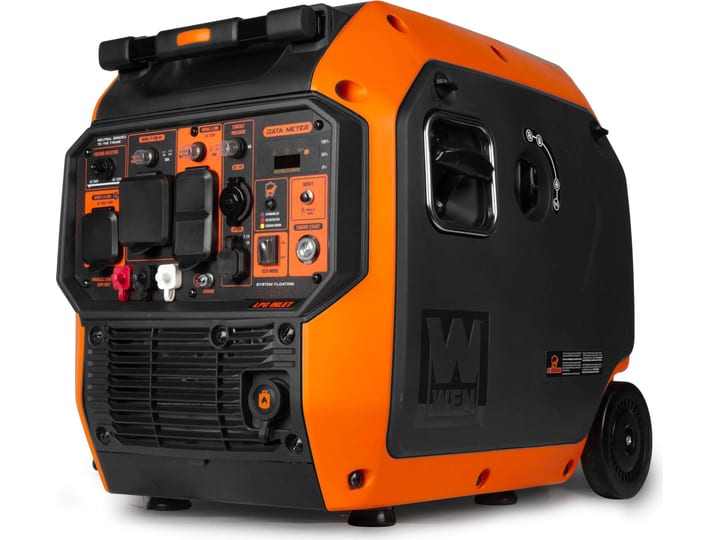
An inverter big enough for the essentials plus a bedroom AC or mini-split, with a 30-amp 240 V outlet for a transfer switch.
Running / surge
5,100 / 6,800 W gas
On propane
4,500 / 6,000 W
Run time
6.1 h gas, 9 h propane at ½ load
Outlets
L14-30R, TT-30R, 2× 5-20R
Weight
94.8 lb
CO shutoff
CO Watchdog
Suits: The essentials plus one cool room, connected through an inlet and an interlock or transfer switch.
Weigh: Ships with a bonded neutral, which decides the kind of transfer switch the electrician fits. Run time on a 20-pound propane tank is about 9 hours at half load.
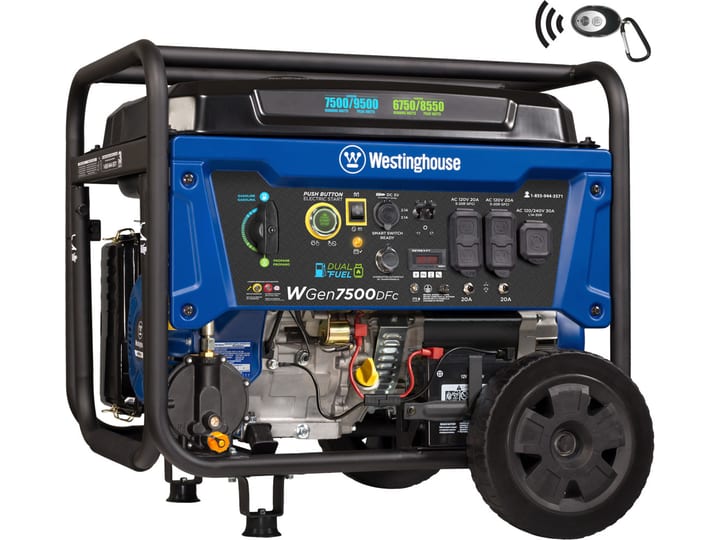
An open-frame dual-fuel unit with remote start and a 30-amp 240 V outlet: more running watts than the inverters, in a heavier, louder package.
Running / peak
7,500 / 9,500 W gas
On propane
6,750 / 8,550 W
Run time
11 h gas at ¼ load
Outlets
L14-30R, 2× GFCI 5-20R
Weight
202.1 lb
CO shutoff
CO Sensor
Suits: The essentials plus a window AC and a well pump, through a 30-amp inlet and transfer switch.
Weigh: About 200 pounds and 72 dBA. Its engine runs at a constant speed, so it uses less fuel at light loads but does not throttle down the way an inverter does. Not sold as CARB compliant.
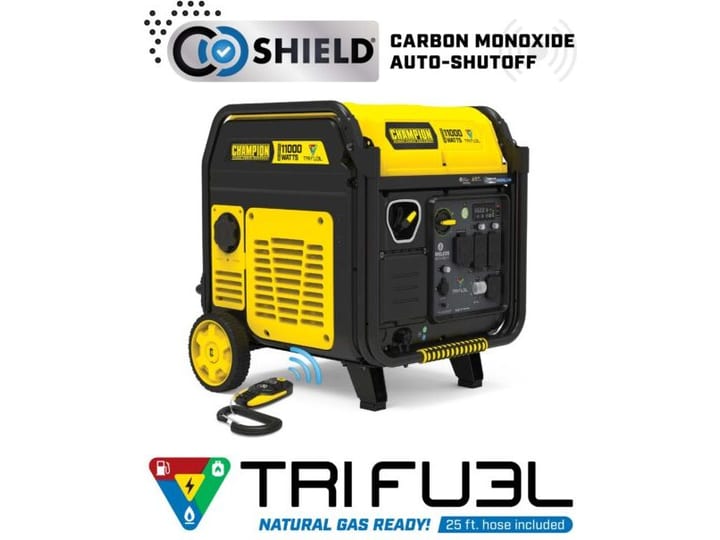
Central-air wattage with inverter manners: quieter than the open-frames, a wireless remote start, and gasoline, propane or natural gas.
Running / starting
9,000 / 11,000 W gas
Propane / natural gas
8,100 / 7,290 W running
Run time
15 h gas at ¼ load
Outlets
L14-30R, 14-50R, 2× GFCI 5-20R
Weight
212.3 lb
CO shutoff
CO Shield
Suits: Whole-house loads through a 50-amp inlet, in a house that already has natural gas or keeps propane on hand.
Weigh: About 212 pounds. Running it on natural gas needs a gas line run to where it sits outside: a gas permit and a plumber, on top of the electrician.
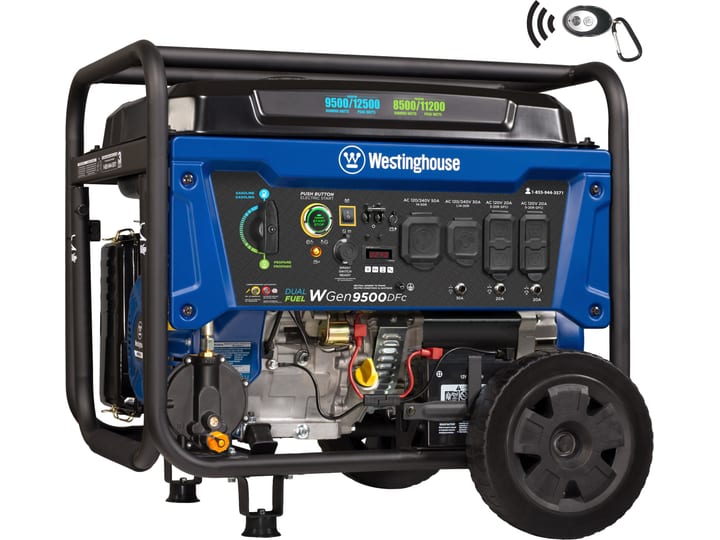
The size where a 3-ton central AC comes into reach, with both a 30-amp and a 50-amp 240 V outlet for the transfer switch.
Running / peak
9,500 / 12,500 W gas
On propane
8,500 / 11,200 W
Run time
12 h gas at ¼ load
Outlets
L14-30R, 14-50R, 2× GFCI 5-20R
Weight
212.1 lb
CO shutoff
CO Sensor
Suits: Central air plus the essentials, through a 50-amp inlet and transfer switch sized by an electrician.
Weigh: About 212 pounds and 74 dBA. On propane it drops to 8,500 running watts, and big loads empty a 20-pound tank in hours, so propane here means several tanks or a larger cylinder.
Cords to plug-in appliances need nothing installed. To run anything hardwired, like a well pump, a ceiling fan circuit or a central AC, the generator feeds the house through an outdoor inlet and listed transfer equipment, so a circuit can never be on the grid and the generator at once.
There are two levels. A 120 V generator can back up selected 120 V circuits through a transfer switch made for that; Reliance, for one, makes UL-listed single-circuit switches for a 15 or 20 amp circuit. Supplying 240 V loads, or a whole panel through an interlock, takes a generator with a 120/240 V outlet (L14-30R or 14-50R). Which equipment fits your generator and your panel is the electrician's call.