Product links on this page go to Amazon. If you buy through them, Electric Tampa earns a commission. How we pick and earn
A power station gets you through the first night of an outage. Solar panels are what get you through the second, third and fourth, when gas stations are dry and the grid is still down. The question is how many panel watts a Tampa Bay day actually turns into stored energy.
Tampa’s sun, month by month
These are peak sun-hours per day from NREL’s PVWatts model for Tampa, for a panel tilted about 28° and facing south: the number of hours a day at full-strength sunlight the panel effectively gets.
| Month | Sun-hours | Month | Sun-hours |
|---|---|---|---|
| January | 5.31 | July | 5.26 |
| February | 5.76 | August | 5.26 |
| March | 6.38 | September | 5.57 |
| April | 6.53 | October | 5.92 |
| May | 6.30 | November | 5.60 |
| June | 5.49 | December | 4.78 |
The year averages 5.68. Hurricane season, June through November, sits a little below spring, with summer’s afternoon clouds. A panel lying flat on the ground does worse in winter: about 3.3 sun-hours in December.
Rated watts aren’t what you get
A “200 W” panel makes 200 W in lab conditions. Outside, heat, dust, wiring and the angle all take a share, and Florida heat takes the biggest one: Jackery rates its SolarSaga panel’s output to fall 0.33% for every degree Celsius of cell temperature, so a cell at 65 °C, common in direct sun on an August afternoon, gives about 13% less.
PVWatts includes those losses. For Tampa it works out to about 4.3 kWh a day for every 1,000 W of panel, averaged over the year, and about 3.8 kWh in the weakest months (December and July).
How many panel watts you need
| To refill each day | Average month | Weakest months |
|---|---|---|
| 1 kWh station | about 230 W | about 265 W |
| 2 kWh station | about 460 W | about 530 W |
Those are typical-weather figures. A gray day after a storm can cut them in half or worse, which is the case for having more panel than the table says, or a station big enough to ride through a bad day.
In practice: two 200 W panels or one 400 W panel keep a 1 kWh station topped up through most of the year, and a 2 kWh station wants 500 to 600 W.
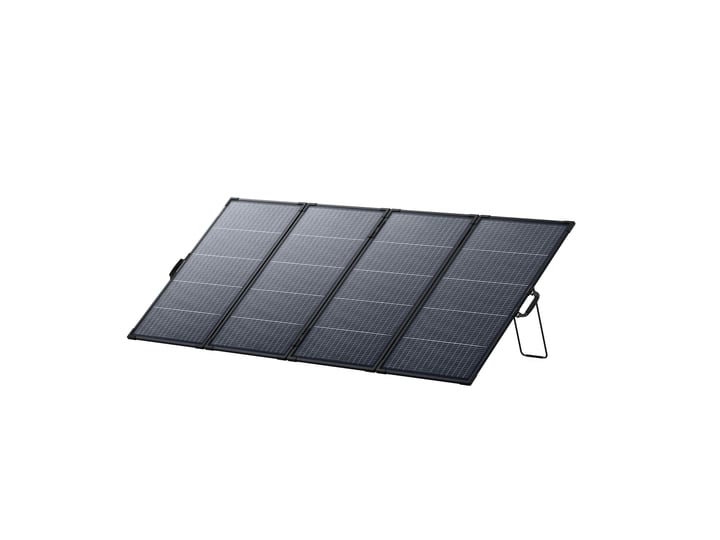
Folding panel, 400 W
Anker SOLIX PS400 Bifacial
Anker SOLIX AS340
One 400 W bifacial panel instead of two 200s: fewer cables, and enough on its own to refill a 1 kWh station on an average Tampa Bay day.
- Rated output
- 400 W
- Cells
- N-type, 25%+
- Output
- 48 V ⎓ 8.33 A
- Weight
- 21.9 lb
- Warranty
- 5 years
- Water
- IP68
Suits: Larger Anker SOLIX stations with high-voltage solar inputs.
Weigh: About 22 pounds and nearly 39 inches long folded. Anker does not publish its open-circuit voltage; confirm your station's input window first.
Series or parallel
Two panels can be wired two ways:
- Series adds the voltages and keeps the current the same. Two panels with an open-circuit voltage (Voc) of 21.5 V give about 43 V.
- Parallel adds the currents and keeps the voltage the same.
Your power station’s solar input has a voltage window and a current limit. In series, the combined open-circuit voltage has to stay under the top of that window, and it rises on cold mornings. Check the station’s manual before you connect anything, and use the connector or adapter the station maker specifies.
Which panels fit which station
These pair each power station we list with panels from the same maker, using the input limits and panel voltages each publishes. Open-circuit voltage (Voc) in series is the number to check against the input window.
| Station | Solar input | Panels that fit | Notes |
|---|---|---|---|
| EcoFlow RIVER 3 Plus | 220 W | One EcoFlow 220W | EcoFlow rates a full charge in about 1.5 hours at 220 W. |
| Jackery Explorer 1000 v2 | 400 W, 12–60 V, two DC8020 ports | Two Jackery SolarSaga 200W | Not listed here: the panels were unavailable on Amazon when we checked. |
| Anker SOLIX C1000 Gen 2 | 600 W, 11–60 V | One Anker PS400 or PS200 | Anker doesn’t publish the panels’ Voc; confirm the pairing, and any second panel, with Anker. |
| BLUETTI Elite 200 V2 | 1,000 W, 12–60 V, 20 A | Two BLUETTI 200W in series (about 49 V Voc) | Three in series would exceed 60 V, so two is the series limit. |
| EcoFlow DELTA Pro 3 | 1,000 W at 11–60 V, plus 1,600 W at 30–150 V | Two EcoFlow 220W in series (about 43 V) on the low port; up to six in series (about 129 V) on the high port | Voltage rises in cold weather; leave margin under 150 V. |
| Anker SOLIX F3800 Plus | Two inputs, 1,600 W each, 11–165 V | Anker PS400 panels | Voc isn’t published, so get the number of panels per input from Anker. |
The Renogy kit is different: its controller charges a 12 V battery, not a power station’s solar port.
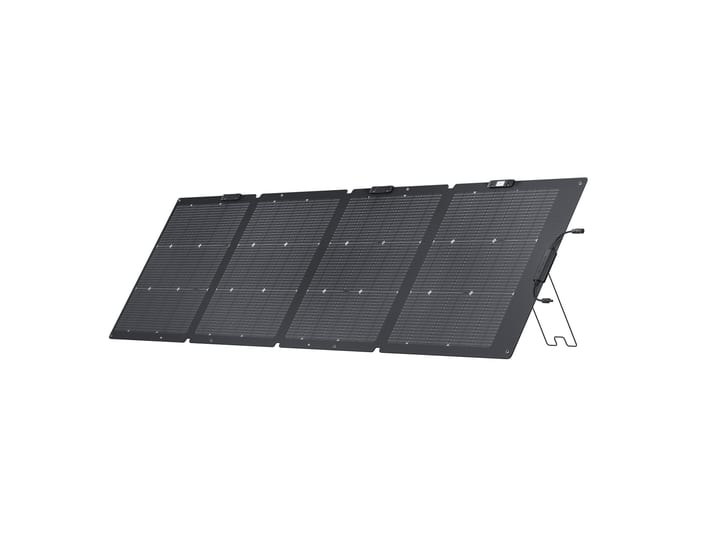
Folding panel, 220 W
EcoFlow 220W Bifacial Portable Solar Panel
EcoFlow 220W Bifacial (N-type)
A folding N-type panel that also collects reflected light from the back, rated 220 W on the front and up to 175 W more on the rear.
- Rated output
- 220 W (+175 W rear)
- Cells
- N-type TOPCon, 25%
- Voc / Isc
- 21.5 V / 12.4 A
- Weight
- 15.4 lb
- Folded
- 24.2 × 23.2 in
- Water
- IP68
Suits: Recharging an EcoFlow power station; two of them refill a 1 kWh station on most Tampa Bay days.
Weigh: Made for EcoFlow inputs. Bifacial gain depends on a bright surface under it, like concrete or sand, not dark grass. 12-month warranty.
Setting up after a storm
- Point the panels south, tilted toward the sun, and move them through the day if you can; flat on the ground gives up a lot in winter.
- Keep them out of shade. Even partial shade cuts a panel’s output sharply.
- Bring them in before the next band of weather. Most folding panels are rated IP67 or IP68 against water, but not against wind.
- Charge the station in the shade, not next to the panels in the sun. Batteries charge slowly or stop when they’re hot.
For a rooftop system instead, see whether rooftop solar keeps the lights on in an outage.