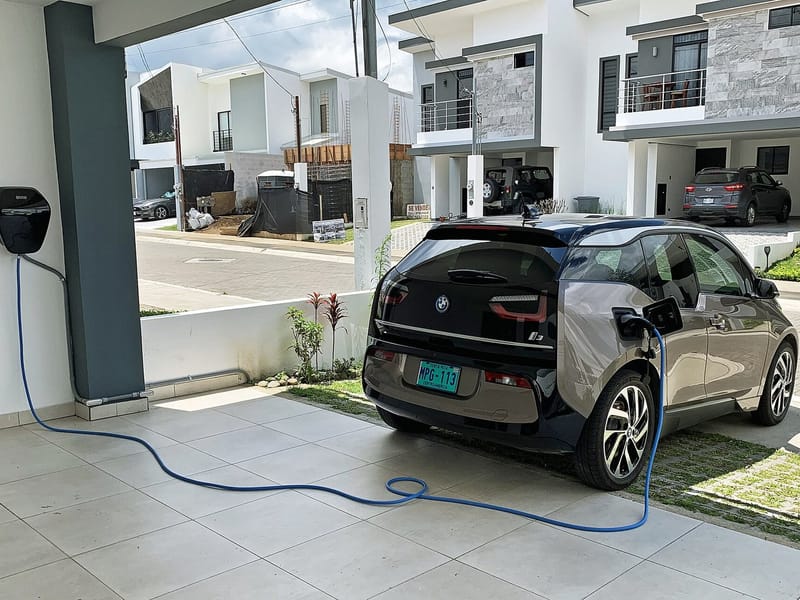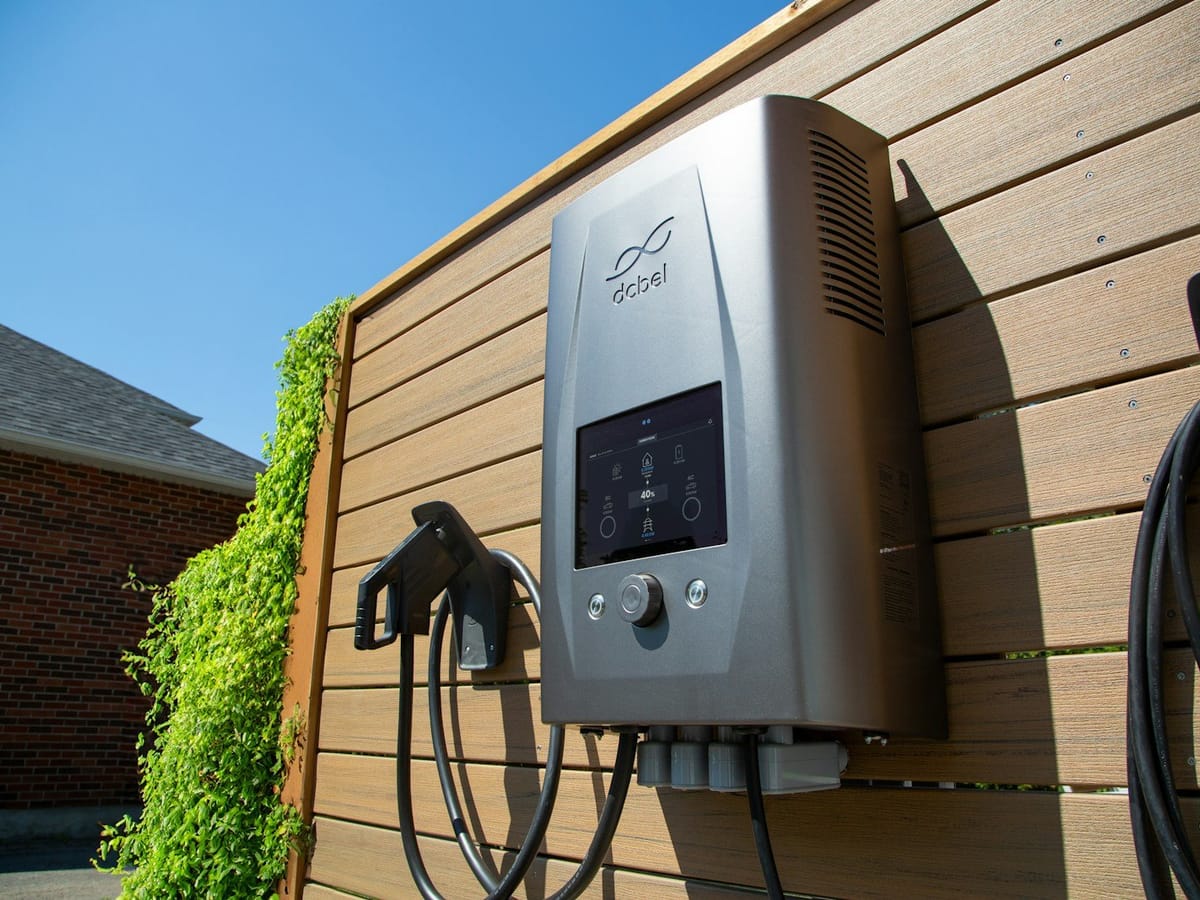
An electric car carries a big battery: often 60 to 100 kWh, several times what a large power station holds. It’s a fair question after Helene and Milton: why can’t it run the house? Some can. Most can’t yet, and none do it with an ordinary charger.
Two different things
- Vehicle-to-load (V2L) means the car has its own household outlets, in the cabin, the bed or through an adapter in the charge port. You run extension cords to the fridge and a fan, the same way you’d use a small generator. Nothing is installed in the house.
- Vehicle-to-home (V2H) means the car feeds the house wiring through a bidirectional charger and transfer equipment that disconnects the house from the grid first. Only certain cars support it, and only with the maker’s equipment.
What it takes, by maker
Tesla Cybertruck: Powershare
Tesla’s Powershare installation manual describes the home backup setup: a Powershare Gateway, a Backup Switch at the meter, and a Universal Wall Connector (or a Powerwall with a Wall Connector). It delivers up to 11.5 kW at 48 A on a 60 A breaker and supports 240 V loads, including air conditioners up to 110 A of starting current. Tesla tells installers the Wall Connector has to be treated as a generation source under the electrical code.
Kia EV9 and EV6: Wallbox Quasar 2
Kia’s vehicle-to-home page pairs the cars with the Wallbox Quasar 2, a bidirectional DC charger rated up to 12 kW. Backup also needs Wallbox’s power meter and power recovery unit, and Kia states that the bidirectional charger can’t power the home in a blackout by itself. It requires a panel of 100 A or more, and permits or utility approval may apply. Kia’s EV9 page notes that the extra equipment is not currently available for purchase, and that home power stops when the car’s battery reaches 20%.
Ford and GM
Ford’s F-150 Lightning and several GM EVs have had their own vehicle-to-home packages, each with a specific bidirectional charger and home transfer equipment from the maker. Their offerings and availability have been changing, and we couldn’t confirm the current details from the makers’ pages, so check with Ford or GM Energy directly before planning around one.
What V2L outlets can do
If your car has household outlets, it can run plug-in loads through extension cords: the refrigerator, fans, phone chargers, a CPAP. Output depends on the car and the outlet, so check the owner’s manual for the rating. It’s the same plan as a small inverter generator, without the fuel or the carbon monoxide.
Rules that don’t change
- Never connect a car’s outlet to house wiring with an adapter or a two-ended cord. That backfeeds the utility’s lines, the same danger as a generator in a dryer outlet.
- A charger that sends power to the house has to be listed for it. The National Electrical Code (section 625.48 in the 2023 edition) requires bidirectional chargers to be listed and marked for that use, and they’re hardwired.
- The transfer equipment is an electrician’s job, with a permit and, where the utility requires it, an interconnection approval.
For an ordinary charger, start with Level 1 or Level 2 at a Tampa Bay house. For backup without a car, compare battery power stations and generators.